

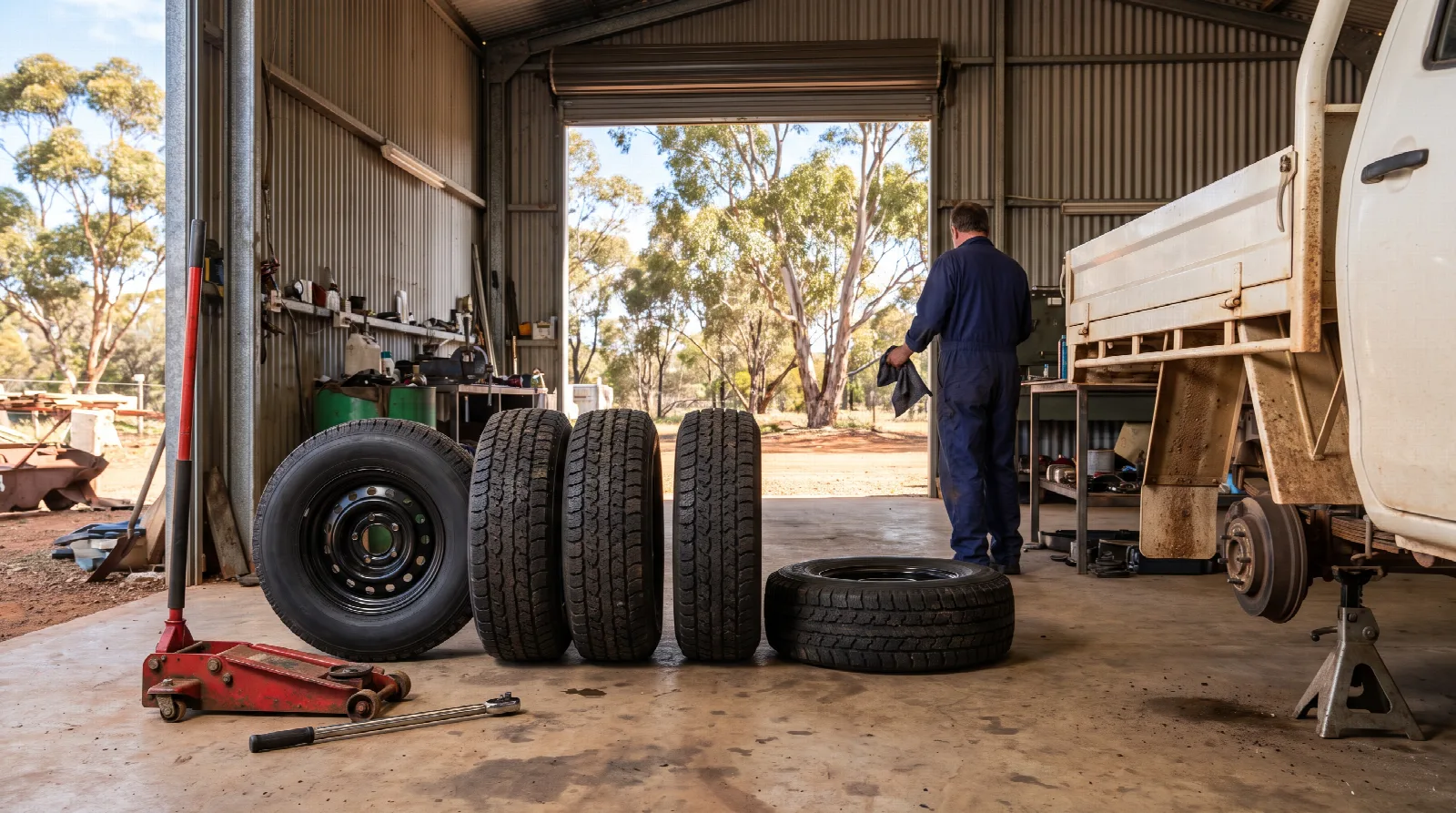
Rotate the tyres on a 4WD about every 10,000 km, and include the spare if it matches the other four. Moving each tyre through every position on the vehicle evens out the wear, so the whole set lasts longer and stays the same diameter, which matters more on a four-wheel drive than on any other vehicle.
This guide covers why 4WD tyres wear unevenly, the five-tyre rotation pattern step by step, which tyres can and cannot be swapped around, and what to check while the wheels are off.
Why 4WD tyres wear unevenly
No two corners of a four-wheel drive do the same job. The front tyres steer, take most of the braking and carry the engine, often with a bull bar and winch hanging out in front of them. The rear tyres carry the tray, the drawers, the fridge and the towball weight of whatever is hooked up behind.
Suspension design adds to it. Most utes and wagons pair independent front suspension with a live rear axle. The front wheels lean in or out slightly as the load changes, while the rear wheels stay square to the road, so the fronts tend to wear on one edge and the rears wear flat. Add a touring load and a few thousand kilometres of gravel and each tyre ends up with a wear pattern of its own.
Left where they are, one pair of tyres is finished well before the other. You end up buying two at a time and driving on tyres with very different tread depths.
Why it matters more on a four-wheel drive
A worn tyre is smaller in diameter than one with deep tread. When the tyres at one end of a full-time 4WD or all-wheel drive are noticeably smaller than those at the other, the two axles turn at slightly different speeds and the driveline has to absorb the difference. Even wear across the set keeps the diameters matched and takes that strain away.
The same thing happens after a puncture if a brand-new spare goes on beside three half-worn tyres. A spare that has been through the rotation is worn about as much as the rest, so it drops straight in.
How often to rotate 4WD tyres
Every 10,000 km is the usual rule, and your owner's manual will give the interval for your vehicle. The easy way to remember is to have it done at each service, when the wheels are coming off anyway.
Shorten the gap to around 5,000 km if your 4WD works hard: heavy touring loads, regular towing, long runs on gravel, or tyres that are already showing uneven wear. New tyres also wear fastest early in their life, so an early first rotation helps the set settle in evenly.
One thing rotation cannot do is fix a fault. Wear caused by the wrong pressures, poor wheel alignment, worn shock absorbers or a badly set-up suspension lift will keep coming back until the cause is repaired. If one edge of a tyre is scrubbing away, have the alignment checked before you move that tyre anywhere.
The five-tyre rotation pattern
If your spare is a full-size match for the tyres on the ground, with the same size, type and load rating, bring it into the rotation. Five tyres sharing the work of four gives you about a fifth more distance from the set, and the spare no longer sits under the tray for years, ageing without ever being used.
For rear-wheel-drive and four-wheel-drive vehicles on ordinary non-directional tyres, the pattern is:
| Tyre now at | Moves to |
|---|---|
| Left rear | Left front |
| Right rear | Right front |
| Right front | Left rear |
| Spare | Right rear |
| Left front | Becomes the spare |
The rear tyres go straight forward, one front tyre crosses to the opposite rear corner, the spare comes into service and the other front tyre takes a rest. Repeat the same moves every time and after five rotations each tyre has done a turn in every position, spare included.
A tip before you start: write the new position on each tyre in chalk while the vehicle is still on the ground. It is surprisingly easy to lose track once five wheels are lying around.
Rotating four tyres without the spare
If the spare is a different size, a different tyre or marked for temporary use, leave it out and rotate the four on the ground. The rear tyres move straight to the front, and the front tyres cross over to the opposite sides at the rear. After four rotations each tyre has been on every corner.
Tyres you should not cross over
Most all-terrain and mud-terrain tyres are non-directional, so the full pattern works. A few set-ups need care:
- Directional tyres have an arrow on the sidewall showing which way they must turn. They can only swap front to rear on the same side of the vehicle, unless the tyre is taken off the rim and turned around.
- Asymmetric tyres have an inner and an outer side. They can go on any corner as long as the side marked "outside" still faces out.
- Different sizes front and rear cannot be swapped between axles at all.
- Temporary and mismatched spares stay out of the rotation. A spare only joins in when it matches the other four in size, type and load rating.
Not sure what you have? Our guide on how to read your tyre size explains every marking on the sidewall.
What to check while the wheels are off
A rotation is the best chance you get to look closely at every tyre, including the inside sidewalls you never normally see.
- Tread wear. Compare the inner edge, centre and outer edge of each tyre. Even wear is what you want. Wear on one edge points to alignment, and wear that differs a lot between tyres means the rotations are too far apart.
- Damage. Look for cuts, bulges and stake marks in the sidewalls, and pick out any stones wedged in the tread.
- Age. Tyres harden as they get older, even with plenty of tread left. See when to replace your tyres for how age and damage affect a tyre.
- Brakes. With the wheels off, the pads, rotors and brake lines are in plain view.
- Pressures. Many 4WDs run different pressures front and rear, so reset every tyre to the placard for its new position, and remember the spare. If you have been off-road, our guide to airing down and back up covers the rest.
- Wheel nuts. Tighten them to the torque in your owner's manual, then check them again after a short drive.
If you do the job at home, work on firm, level ground and never get under a vehicle held up only by a jack. Use axle stands. If you would rather hand it over, a local workshop or mobile fitter near you can do the rotation for you.
Buying five tyres instead of four
Five-tyre rotation only works if all five tyres match, so the best time to start is with a fresh set. Buying five means the spare is the same tyre, the same age and the same diameter as the rest from day one, which is exactly what a four-wheel drive wants when a puncture happens a long way from town.
In 265/70R17, a common 17-inch all-terrain size, the Roadking Argos AT08 and the PowerTrac WildRanger AT are both in stock. In the larger 285/70R17, the Keter HyperTrax and the Rapid EcoLander are light-truck all-terrains. You can also browse every all-terrain tyre we stock.
Whichever tyre you choose, the load index and speed rating must meet or exceed the figures on your vehicle's tyre placard. The tyre guide walks through how to match them.
Common questions
How often should I rotate my 4WD tyres?
About every 10,000 km, or at each service. Bring it forward to around 5,000 km if you tow, carry heavy loads, drive a lot of gravel or can already see uneven wear.
Should I include the spare in a tyre rotation?
Yes, if it is a full-size spare that matches the other four in size, type and load rating. You get about a fifth more life from the set and the spare stays in usable condition. Temporary spares are left out.
Can I rotate directional tyres?
Only front to rear on the same side of the vehicle. Swapping them to the other side would make them turn backwards, so they would have to be removed from the rim and refitted first.
Does rotating tyres fix uneven wear?
No. Rotation spreads normal wear evenly across the set. Wear caused by wrong pressures, poor alignment or worn suspension parts needs the cause fixed, or the next tyre in that position will wear the same way.